
Occupational therapy for dementia
With dementia, familiar surroundings are not a side issue but part of the therapy. That is why I come to your home – around Landau, Offenbach an der Queich and the Southern Wine Route.
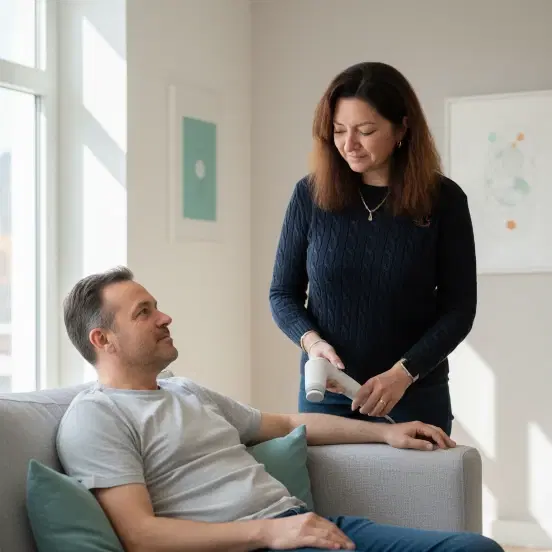
Why changing location often does more harm than good
Unfamiliar rooms cost people with dementia energy that is then missing from the therapy itself. At home, habit and recognition work in our favour: the route to the coffee pot, the usual seat at the table, the view from the window are anchors. We work with those anchors rather than against the unease of a strange waiting room.
What we work on
The focus depends on the stage and on what currently weighs most heavily in daily life:
- Maintaining everyday actions – dressing, personal care, eating, small household tasks
- Challenging memory, attention and concentration without overwhelming
- Supporting orientation within the home and through the daily routine
- Strategies that compensate for declining abilities
- Making the living space safer and reducing fall risks
- Preserving familiar activities and interests for as long as possible
Structure instead of overload
The aim of treatment is not to recover lost abilities. It is to use what remains, avoid overload, and structure the day so that it can succeed. What worked yesterday and no longer works today, we replace with something that holds.
Relief for relatives
Anyone caring for a person with dementia is often at the limit of their own strength. A large part of my work is guiding relatives: how do I speak when something is no longer understood? When do I help, when do I wait? How do I arrange the home so that less goes wrong? This advice is explicitly part of the treatment – you do not have to ask for it separately.
Common questions about occupational therapy for dementia
What does occupational therapy for dementia involve in practice?
At which stage of dementia is occupational therapy useful?
How often should sessions take place?
Are relatives involved?
This treatment as a home visit
I treat exclusively at your home – no waiting room, no journey. I travel regularly to Offenbach an der Queich, Landau in der Pfalz, Annweiler am Trifels, Bad Bergzabern, Edenkoben, Herxheim bei Landau and the surrounding area of the Southern Wine Route.
My services are for private patients and self-payers. If you would like the treatment without a medical prescription, that is possible – simply say so when you get in touch.
Sources and further information
External sites. Their providers are responsible for the content.