
Occupational therapy after a stroke
The hardest part begins after hospital: everyday life within your own four walls. That is exactly where I start – with home visits around Landau, Offenbach an der Queich and the Southern Wine Route.
Why therapy at home makes particular sense
In hospital you practise what works in the therapy room. At home you find out what actually holds up: the narrow bathroom door, the coffee machine with the stiff lever, the staircase without a second handrail. We practise with your objects, in your rooms, for your routes. What works here will work again tomorrow.
What we work on
Depending on how the stroke affected you, different goals come to the fore:
- Movement and strength in the affected hand and arm
- Fine and gross motor skills for everyday actions – buttons, cutlery, opening bottles
- Managing dressing, personal care and eating independently again
- Confidence when walking and standing, reducing fall risks in the home
- Perception and attention, for example when one side of the body is neglected
- Memory, concentration and planning of actions
- Advice on assistive devices and adaptations in the home
Also for spasticity and muscle tone problems
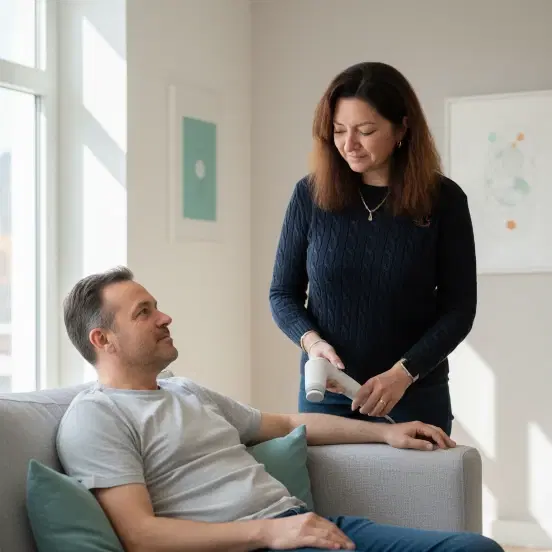
Where muscle tone is increased, I use Novafon therapy among other approaches – a local vibration treatment with a certified medical device. It can support tone regulation and combines well with the other exercises. On request I will show you and your relatives how to apply it between appointments.
No prescription, no long wait
You do not need a prescription if you wish to receive treatment as a self-payer. Especially after discharge from rehabilitation, every week counts – I can usually offer an appointment within one to two weeks.
For relatives
Many calls reach me not from those affected but from daughters, sons and partners. That is entirely fine. Relatives are welcome at appointments, and it is often helpful: you learn which kinds of help support progress and where stepping back lets independence grow rather than fade.
Common questions about occupational therapy after a stroke
What does occupational therapy after a stroke achieve?
When should occupational therapy start after a stroke?
How long does occupational therapy after a stroke take?
Is occupational therapy still worthwhile years after a stroke?
This treatment as a home visit
I treat exclusively at your home – no waiting room, no journey. I travel regularly to Offenbach an der Queich, Landau in der Pfalz, Annweiler am Trifels, Bad Bergzabern, Edenkoben, Herxheim bei Landau and the surrounding area of the Southern Wine Route.
My services are for private patients and self-payers. If you would like the treatment without a medical prescription, that is possible – simply say so when you get in touch.
Sources and further information
External sites. Their providers are responsible for the content.