
Occupational therapy for Parkinson's
Parkinson's changes daily life in many small steps – buttoning a shirt, standing up, turning around in the hallway. I work with you exactly where those steps happen: at your home around Landau and the Southern Wine Route.
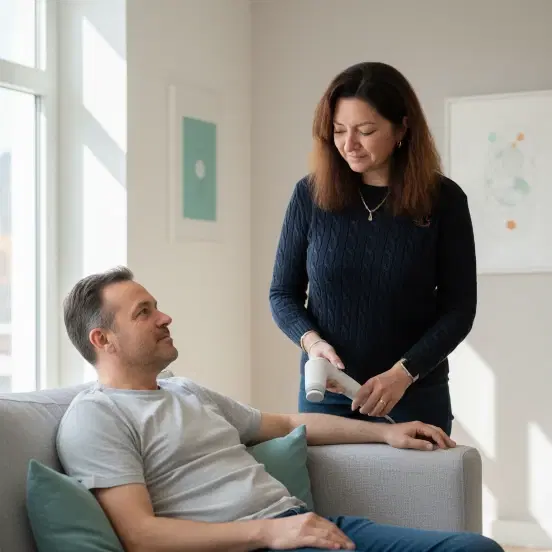
What we work on
Which priorities make sense depends on how the condition shows itself in your case:
- Fine motor skills for buttons, zips, cutlery and writing
- Initiating movement sequences when they stall
- Standing up, turning and walking safely within your own home
- Fall prevention and adapting critical spots in the living space
- Maintaining everyday activities such as dressing, personal care and eating
- Planning of actions, concentration and attention
- Advice on assistive devices that will actually get used
Practising where it counts
With Parkinson's, transferring skills from a therapy room to your own home often works less well than with other conditions – precisely because narrow spaces, thresholds and floor coverings matter so much. At home that transfer is unnecessary. We practise turning around in your hallway, not in a training room.
Also for tension and increased muscle tone
Where useful, I add Novafon therapy – a local vibration treatment with a certified medical device. It can be used for muscular tension and to support tone regulation.
Practising across the day: better and weaker phases
With Parkinson's the time of day often matters more than the day of the week: at some hours movements work almost as usual, at others hardly at all. Because I come to you, the appointment can be placed where experience shows you gain most from it. And we practise specifically for the weaker phases: which movements still work then, which aids should be within reach, and how to carry on safely when a movement blocks.
No prescription and no long wait
Parkinson's is progressive, so waiting time is not merely inconvenient – it costs practice time. As a self-payer you need neither a medical prescription nor a place on a waiting list, and I can usually offer appointments within one to two weeks. If you want to submit the costs to your insurer, a prescription is worth having – just let me know when you get in touch.
For relatives
Parkinson's fluctuates – good days, harder days, differences across a single day. That is difficult for relatives to judge and easily leads to too much or too little support. I will show you what to look for and how to build exercises into daily life without turning it into a second therapy programme.
Common questions about occupational therapy for Parkinson's
Does occupational therapy help with Parkinson's?
What does an occupational therapist actually do for Parkinson's?
What is the difference between occupational therapy and physiotherapy for Parkinson's?
Is occupational therapy useful with strong fluctuations during the day?
This treatment as a home visit
I treat exclusively at your home – no waiting room, no journey. I travel regularly to Offenbach an der Queich, Landau in der Pfalz, Annweiler am Trifels, Bad Bergzabern, Edenkoben, Herxheim bei Landau and the surrounding area of the Southern Wine Route.
My services are for private patients and self-payers. If you would like the treatment without a medical prescription, that is possible – simply say so when you get in touch.
Sources and further information
External sites. Their providers are responsible for the content.